GMAN
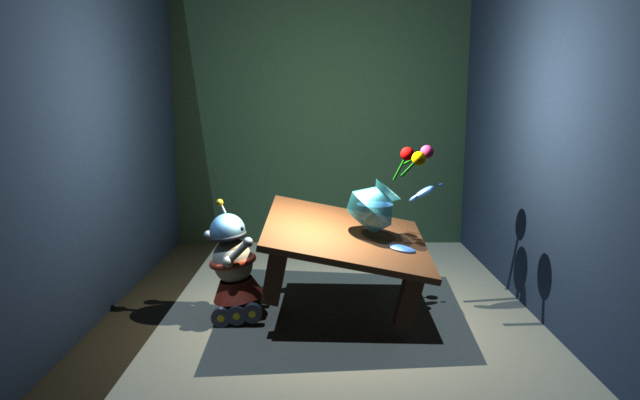
GMAN is an open-source, RenderMan-compatible renderer. Point it at a .rib file and choose a renderer with -r. gmanzbuffer is the default preview. gmanraytracer adds shadows, reflection, refraction and transparency. gmanpathtracer adds light bounced off every surface, soft shadows from area lights and glossy reflection.
Get it
Download the build for your machine from the releases page: Linux x86_64, Linux arm64 or macOS arm64. Then unpack it and install:
tar xzf gman-1.0.0-linux-x86_64.tar.gz
cd gman-1.0.0-linux-x86_64
sudo ./install.sh
The runtime libraries, another prefix and uninstalling are in the README.
Ray trace it
From the unpacked folder:
gman -r gmanraytracer samples/vase.rib
That writes vase.png, a ray-traced render of the scene above, in a few seconds.
Path trace it
Add one line to samples/vase.rib, under PixelSamples 2 2, and render it through the path tracer:
Option "pathtracer" "integer samples" [64]
gman -r gmanpathtracer samples/vase.rib
That writes the picture at the top of this page. Sixty-four paths through each of the four subpixels follow the light as it bounces off the walls, floor and table. The render takes about three minutes on one core of an Apple M3 Max, where the ray tracer takes seconds. The path tracer computes the bounce light the scene's ambientlight stood in for, so it skips that light and says so:
gmanpathtracer: ambientlight lights nothing under the path tracer; skipped 1 light(s).
Bounce light under the ray tracer
The ray tracer adds bounce light through a radiosity pass. Add one line to samples/vase.rib, under PixelSamples 2 2, and render it through the ray tracer as before:
Option "render" "string indirect" ["radiosity"]
The pass dices the scene into patches and solves the diffuse light bouncing between them by progressive refinement, colour bleeding included. Each surface picks the result up through ambient(), weighted by its own Ka. Set Ka equal to Kd on each Surface and drop the ambientlight, which the pass replaces. Option "radiosity" "float elementsize" sets the patch size, an eighth of the scene's largest side by default.
Poke it
Change one line of samples/vase.rib and render it again with gman -r gmanraytracer samples/vase.rib. Each picture starts from the original scene.
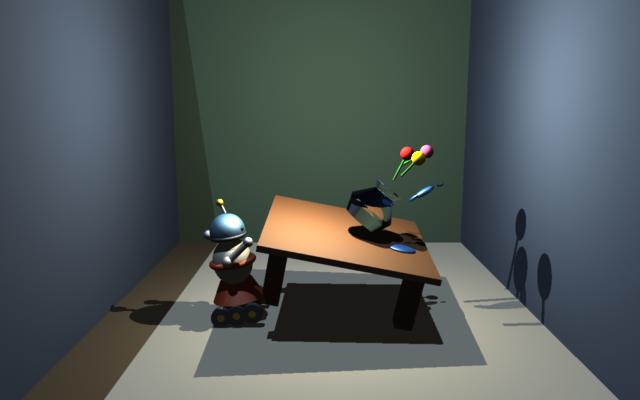
Glass vase. In the ## Vase block, make the surface Surface "glass" and delete the Opacity.
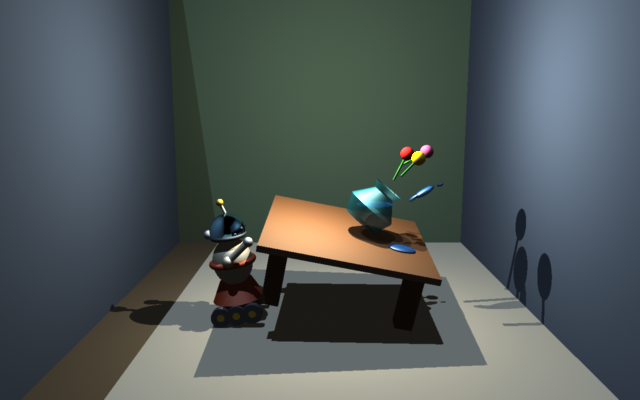
Mirror dome. Under # head dome, make the surface Surface "mirror" "Kr" [1].
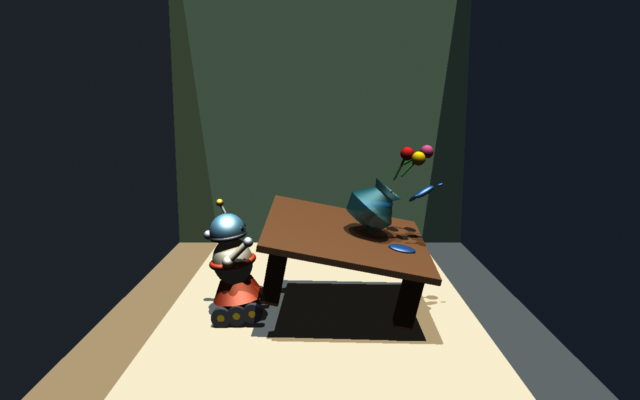
Sunlight. Swap the lamp for the sun: LightSource "distantlight" 2 "intensity" [1.2] "lightcolor" [1 0.95 0.83] "from" [1 3 10] "to" [0 0 1]. The walls now shadow the room.
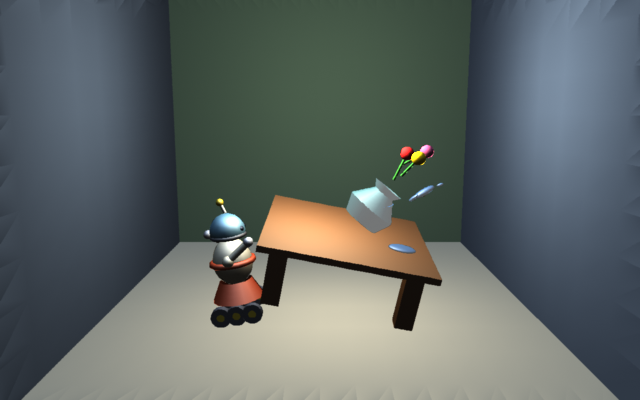
The z-buffer. No edit: plain gman samples/vase.rib renders the fast preview, without shadows, reflection or refraction.
What it renders
- Geometry.
Polygon,GeneralPolygon,PointsPolygons,PointsGeneralPolygonsand the seven quadrics,Sphere,Cone,Cylinder,Hyperboloid,Paraboloid,DiskandTorus, under every renderer.PatchandPatchMesh, bilinear and bicubic, andNuPatchunder the z-buffer. - Surface shaders.
matte,plastic,paintedplastic,metalandshinymetalunder every renderer;glassandmirrortrace rays, so they need the ray tracer or the path tracer. - Light shaders.
ambientlight,distantlight,pointlightandspotlight, andAreaLightSource "arealight", which makes theSphereorDiskafter it glow under the path tracer. - Three renderers.
gmanzbuffer, the default preview;gmanraytracer, with shadows, reflection, refraction and transparency; andgmanpathtracer, which adds light bounced off every surface, soft shadows from area lights and glossy reflection. - Bounce light. Under the ray tracer,
Option "render" "string indirect" ["radiosity"]adds a radiosity pass: it solves the diffuse light bouncing between surfaces, colour bleeding included, and each surface picks it up throughambient(), weighted by itsKa.Option "radiosity" "float elementsize"sets the solver's patch size, an eighth of the scene by default. SetKaequal toKdand drop theambientlight, which the pass replaces. - Antialiasing.
PixelSamplessupersamples;PixelFilterreconstructs through box, triangle, Gaussian, Catmull-Rom or sinc. - Textures.
texture()andenvironment()read maps written byMakeTextureandMakeLatLongEnvironment. - RIB. Plain or gzip'd, with
ReadArchive. An unrecognized request warns once and is skipped. - Image drivers. TIFF, PNM, PNG and JPEG;
gman --versionlists the ones built in.
A first scene
Eleven lines, from nothing. Save them as first.rib:
Display "first.png" "file" "rgba"
Format 640 400 1
Projection "perspective" "fov" [30]
Translate 0 0 6
WorldBegin
LightSource "ambientlight" 1 "intensity" [0.2]
LightSource "distantlight" 2 "from" [-2 2 -3] "to" [0 0 0]
Surface "plastic"
Color [0.9 0.25 0.2]
Sphere 1 -1 1 360
WorldEnd
gman -r gmanraytracer first.rib
Build from source
Requires CMake 3.21 or newer, a C++20 compiler with <format> (GCC 13 or Clang 17 or newer), libtiff and zlib. libpng and libjpeg are optional: a build without one rejects that Display extension with RIE_BADFILE, and gman --version lists the drivers compiled in. POSIX only: macOS and Linux.
git clone https://github.com/jac18281828/gman.git
cd gman
cmake --preset dev
cmake --build build --parallel
To install into a prefix:
cmake --install build --prefix /usr/local
The installed prefix carries bin/gman and a CMake package. A program links gman with find_package(gman CONFIG REQUIRED) and target_link_libraries(app PRIVATE gman::gman_core), and includes <gman/ri.h>.
New to RenderMan?
RenderMan is the interface Pixar published for turning a 3D scene description into an image: cameras, geometry, lights and shaders, all in a plain-text RIB file. It's the API behind decades of film rendering, but the implementations that speak it are proprietary, heavyweight, or both.
Where to find it
GitHub, with its releases and changelog, and the original SourceForge site. Begun in 1999, revived in 2026, licensed LGPL-2.1-or-later.